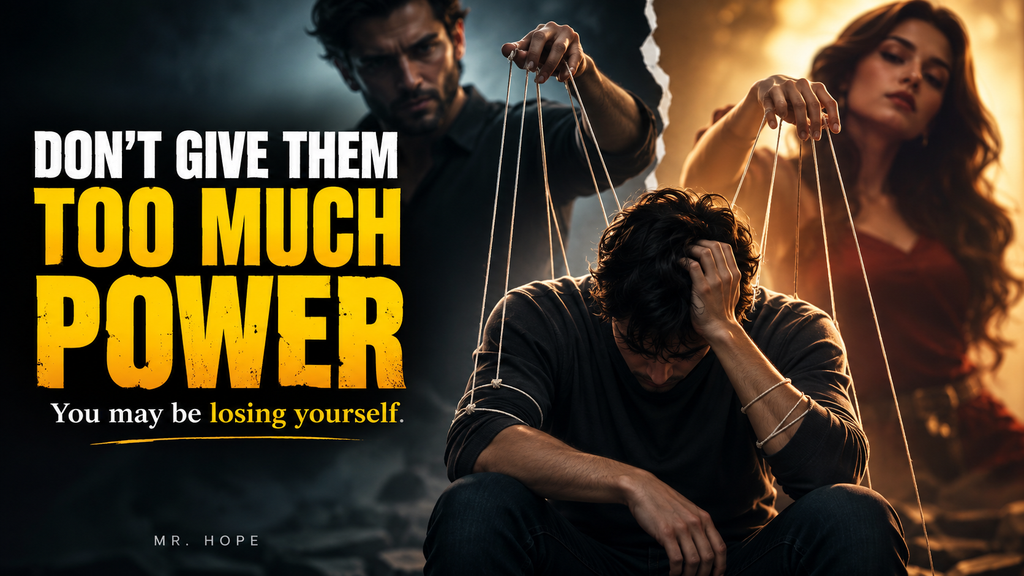
We often hear people say, “Love hurts.” But sometimes, love isn’t really what hurts us. What hurts is the amount of power we give another person over our emotions, our decisions, our happiness, and eventually, our identity.
It can happen slowly. Someone enters your life and becomes important to you. You start thinking about them more often. Their messages matter. Their attention makes your day, while their silence makes you anxious. Before you realize it, their presence has started occupying more space in your mind than your own life.
When Someone Becomes the Centre of Your World
There is nothing wrong with loving someone deeply. Caring about another person’s feelings, wanting them to be happy, and enjoying their presence are natural parts of human connection.
The problem begins when that person becomes the centre of your existence. You stop living your life and start living your life around them. Their happiness becomes your happiness. Their sadness affects your mood. Their approval begins to feel like validation, while their rejection starts feeling like a rejection of your entire self.
You may not even realize when it happens. One day, you simply notice that most of your thoughts are about one person.
You Stop Asking What You Want
When we become emotionally attached to someone, we can become so focused on keeping them happy that we forget to ask ourselves what makes us happy.
You stop asking, “What do I want from my life?” and start asking, “What do they want from me?” You stop thinking about your own goals and begin thinking about how to get their attention, approval, or affection.
Slowly, your own identity can become less important than the relationship you are trying to protect.
And that’s when you need to pause and ask yourself: “Who am I outside this person?”
🎥 Watch the Video version of this article here
When Their Behaviour Controls Your Emotions
Imagine waking up in a perfectly good mood, checking your phone, and realizing that someone you care about hasn’t replied.
Suddenly, your mood changes.
You start wondering what happened. You check your phone again. You replay your last conversation in your head. You wonder whether you said something wrong.
Then, hours later, they finally message you warmly.
And suddenly, you’re happy again.
Nothing significant changed in your own life. But your emotional state changed completely because of another person’s behaviour.
When someone’s attention can make you feel valuable and their distance can make you feel worthless, you’ve probably given that person more control over your emotional world than you intended.
You Cannot Make Someone Love You
Perhaps one of the hardest lessons in relationships is accepting that you cannot make someone love you.
You can be kind. You can be patient. You can give more. You can explain yourself. You can change yourself. You can keep trying.
But you cannot negotiate someone’s feelings.
If someone doesn’t feel the same way, trying harder doesn’t necessarily make them fall in love with you. Sometimes, it simply makes you lose more of yourself in the process.
And this doesn’t necessarily make them a bad person. They may simply not feel what you feel. You are not wrong for loving them, and they are not necessarily wrong for being unable to return that love.
But once you understand that, what you do next becomes your responsibility.
(But Do you really understand that you have limited time on this planet and these complications you dont need in life.Read this article “what if it was your last february” and you will realise that how we are entangled with people and situations as life slips by.)
Don’t Make Someone Responsible for Your Happiness
One of the most dangerous things we can do is make another person responsible for our happiness.
We start expecting them to remove our loneliness, give us confidence, make us feel important, and constantly reassure us that we are worthy.
But no person can permanently carry that responsibility for you.
Your happiness needs more than one source. It needs your own goals, your friendships, your family, your health, your work, your interests, your growth, and most importantly, your relationship with yourself.
A person can be an important part of your life without becoming your entire life.
Taking Your Power Back
Taking your power back doesn’t mean becoming cold. It doesn’t mean stopping yourself from loving. It doesn’t mean pretending that you don’t care.
It simply means remembering that you still exist independently of the person you love.
You can love someone and still have boundaries. You can care about someone and still choose yourself. You can miss someone without abandoning your own life.
You can want someone without needing them to validate your worth.
And you can accept that someone may not choose you without deciding that you are not worthy of being loved.
Find Yourself Again
If you feel that you’ve lost yourself in someone, don’t try to rebuild your entire life overnight.
Start returning to the things that made you feel like yourself.
Return to the goals you neglected. Reconnect with people you stopped talking to. Pick up the hobbies you abandoned. Work on your health. Read. Travel. Create something. Spend time alone without constantly checking your phone.
Every time you make a decision based on what you genuinely want, you take another small piece of your identity back.
You don’t have to stop loving someone to start loving yourself again.
(Do you understand how getting attached to people and things ruin your mental peace.Read this article “Owned by things” to get the reality of owning things)
Love Should Add to Your Life, Not Replace It
A healthy relationship should add something meaningful to your life. It shouldn’t require you to give up your identity to keep it alive.
You should be able to say, “I love you, but I am still me.”
“I care about you, but I won’t abandon myself for you.”
“I want you in my life, but I don’t need to lose myself to keep you there.”
That’s not selfishness.
That’s self-respect.
Don’t Lose Yourself While Trying to Gain Someone Else
Sometimes, the person you’re desperately trying not to lose isn’t the person you’re actually losing.
You’re losing yourself.
Before you spend all your energy trying to make someone stay, pause for a moment and look at your own life.
Look at the person you were before you started chasing their attention. Look at the dreams you put aside. Look at the friendships you neglected. Look at the parts of yourself you slowly stopped expressing.
And then ask yourself one simple question:
“Where did I go?”
Maybe it’s time to come back.
📚 Books That Can Help You Stop Losing Yourself
If you often put everyone else’s needs before your own, struggle to say no, or feel guilty whenever you choose yourself, these books can help you understand the psychology behind the pattern and learn healthier ways to live.
1. Set Boundaries, Find Peace — Nedra Glover Tawwab
If you struggle to say no without feeling guilty, this is an excellent place to start. The book offers practical guidance on creating healthy boundaries in relationships, family, work, and everyday life.
Best for: Learning to protect your time, energy, and emotional space.
2. The Disease to Please — Harriet B. Braiker
Why do we constantly try to make everyone happy—even when it leaves us exhausted?
This book explores the psychology of people-pleasing and the emotional price we can pay when our need for approval becomes stronger than our own needs.
Best for: Understanding people-pleasing and the fear of disappointing others.
3. The Courage to Be Disliked — Ichiro Kishimi & Fumitake Koga
This book challenges the idea that you need everyone’s approval to live a meaningful life. It explores personal responsibility, relationships, freedom, and the courage to live according to your own values.
Best for: Letting go of excessive concern about what other people think.
4. Essentialism — Greg McKeown
Your time and energy are limited. You cannot give them equally to everyone.
Essentialism teaches you to distinguish between what is genuinely important and what is merely demanding your attention.
Best for: Learning to say no to the non-essential and focus on what truly matters.
(Disclosure: Some of the links above are Amazon affiliate links. If you purchase a product through these links, I may earn a small commission at no additional cost to you. As an Amazon Associate, I earn from qualifying purchases. I only recommend books that I believe may provide value to readers.)
- Losing Yourself in a Relationship? Stop Giving Others Too Much Power
 We often hear people say, “Love hurts.” But sometimes, love isn’t really what hurts us. What hurts is the amount of power we give another person over our emotions, our decisions, our happiness, and eventually, our identity. It can happen slowly. Someone enters… Read more: Losing Yourself in a Relationship? Stop Giving Others Too Much Power
 - You Are Your Only Competition: The Daily Battle That Defines Your Life
 Every day, whether we realise it or not, we have a small battle with ourselves. It might happen when the alarm rings and you decide whether to get out of bed or sleep for another twenty minutes. It might happen when you know… Read more: You Are Your Only Competition: The Daily Battle That Defines Your Life
 - You’re Just a Speck of Dust — And That Can Set You Free
 A change in perspective that can help you stop overthinking and live more freely Have you ever noticed how easily a small problem can take over your entire mind? Something someone said, a mistake at work, a failed plan, a financial concern, or… Read more: You’re Just a Speck of Dust — And That Can Set You Free
 - Still the Same After 5 Years? The Truth About Learning, Unlearning & Relearning
 The Question Most People Avoid Learning unlearning and Relearning !!! Have you heard it ???NO?? or YES?? Dont worry you will understand in next few minutes. Look at yourself 5 years ago. Now look at who you are today. Are you really different…… Read more: Still the Same After 5 Years? The Truth About Learning, Unlearning & Relearning
 - Owned by Things? The Truth About Material Attachment That Steals Your Peace
 You buy something new—a bike, a phone, or maybe a car. At first, it feels amazing ,but this deep material attachment often comes with a hidden cost. You keep looking at it again and again. You clean it, protect it, and make sure… Read more: Owned by Things? The Truth About Material Attachment That Steals Your Peace